Apple (AAPL): Growth Slowing, Valuation Stretched, -28% Projected
5 Year Overview
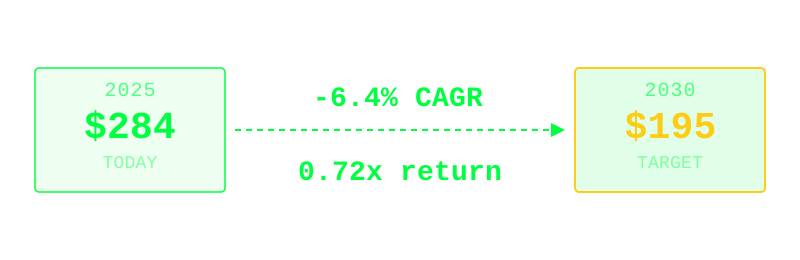
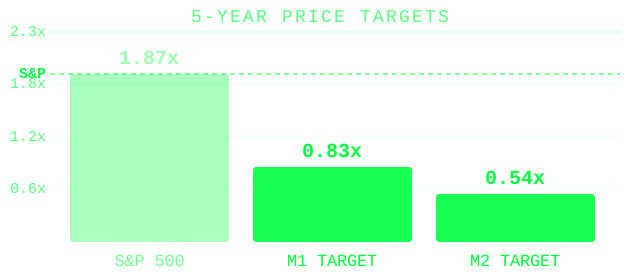
Right now, Apple Inc. trades at $284. Based on its historical financial performance, the data points to $195 in five years — that is 0.72x, or -6.4% CAGR. The S&P 500 is projected at 1.87x over the same period. That puts it 115% behind the S&P 500 over the same period.
Why 0.72x in 5 Years?
EBITDA Method
The current EBITDA is $145B and is projected to reach $184B in five years — that is 5.3% annual growth. Applying the sector's historical multiple of 19x EV/EBITDA gives a price target of $237, or 0.83x from today — behind the market.
Apple's gross margin has shown a consistent upward trend, expanding from 41.8% in FY2021 to 46.9% in FY2025, indicating strong pricing power and efficient cost control. This margin trajectory implies the business is becoming more profitable per dollar of revenue, which is a positive sign for its core operational efficiency.
Free Cash Flow Method
The current free cash flow is $99B and is projected to reach $96B in five years — that is -0.7% annual growth. With an estimated FCF yield of 4.3%, this gives a price target of $153, or 0.54x from today — behind the market.
While revenue has grown, Free Cash Flow has seen a slight decline over the past five years, suggesting the company is not converting revenue into cash at a higher rate. Operating cash flow has generally remained robust, but increased capital expenditures, particularly in FY2025, indicate a tension between cash generation and ongoing reinvestment needs.
Blending both methods, the data points to $195 in five years, against today's $284.
Is It Still Growing?
Revenue
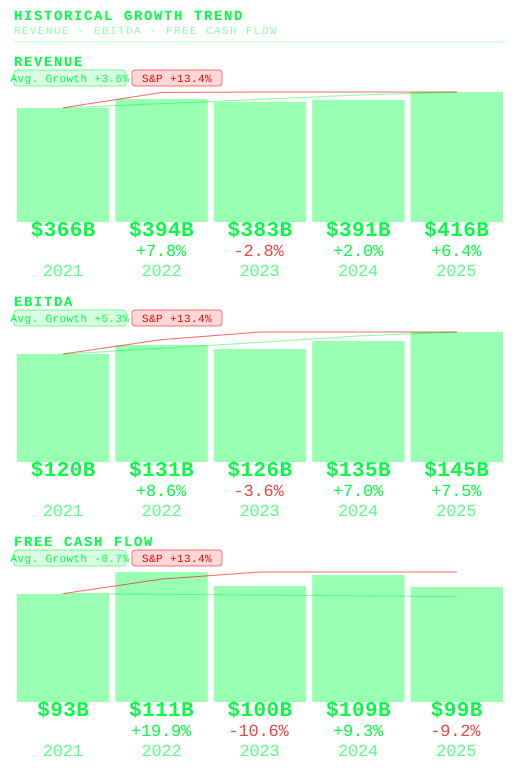
In FY2025, Apple Inc. brought in $416B in revenue, with a 5-year CAGR of 3.6%.
Apple experienced its largest revenue year-over-year increase in FY2022, growing by 7.8%. This surge was likely driven by strong demand for new product cycles, particularly the iPhone, and continued expansion in key geographic markets.
EBITDA
In FY2025, EBITDA came in at $145B, with a 5-year CAGR of 5.3%.
The most significant income swing occurred in FY2025, with net income growing by an impressive 19.5%. This substantial increase was likely driven by a favorable product mix, particularly the higher-margin Services segment, and effective cost leverage across the business.
Free Cash Flow
Free cash flow for FY2025 was $99B, with a 5-year CAGR of -0.7%.
Apple's Free Cash Flow saw its largest positive swing in FY2022, increasing by 19.9%. This robust growth was primarily driven by a significant increase in operating cash flow, reflecting strong demand and efficient working capital management during that period.
Growth Overview
While revenue and EBITDA CAGRs show acceleration over the last three years compared to five years, Free Cash Flow growth has decelerated, even turning negative. This aligns with our signals indicating solid growth in revenue and income, but slowing growth in FCF. Overall, this suggests Apple is a mature grower with strong top-line and profitability, but cash generation is facing headwinds, potentially due to increased reinvestment or working capital changes.
Financial Health
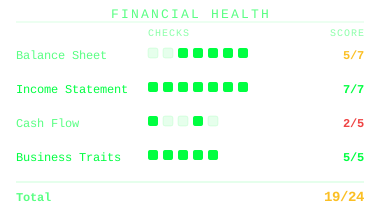
19 out of 24 checks passed.
Apple failed several key health checks, including "Cash/Debt > 1.0", "Debt/Equity < 80%", "OCF > Net Income", "FCF Growth Trend", and "Payout Ratio < 1". Despite these concerns, the company consistently passed "Gross Margin > 40%", indicating strong operational profitability, but the balance sheet and cash flow consistency present an overhang.
For the full breakdown, see the detailed analysis on StockSnack:
→ StockSnack Home — https://stocksnack.app
→ AAPL Full Analysis (Pro Only) — https://stocksnack.app/screener/AAPL
What Does Apple Inc. Actually Do?
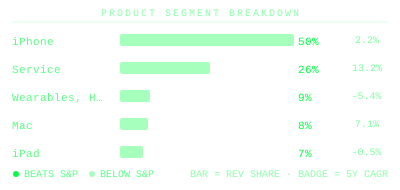 Top 1: iPhone — 50% of revenue.
Representing $209.59 billion and 50.4% of revenue, iPhone remains Apple's core product, driving its ecosystem and brand loyalty despite a modest 2% CAGR.
Top 2: Service — 26% of revenue.
This high-margin segment, generating $109.16 billion and 26.2% of revenue, is a key growth driver with a 13% CAGR, enhancing customer stickiness and recurring revenue.
Top 3: Wearables, Home and Accessories — 8.60% of revenue.
Contributing $35.69 billion and 8.6% of revenue, this segment, including Apple Watch and AirPods, faces challenges with a -5% CAGR, possibly due to market saturation or intense competition.
Growth by Segment
All Segments by Growth (S&P 500 benchmark: 13% CAGR):
- Service: 13% CAGR — This high-margin segment, generating $109.16 billion and 26.2% of revenue, is a key growth driver with a 13% CAGR, enhancing customer stickiness and recurring revenue.
- Mac: 7.1% CAGR — With $33.71 billion and 8.1% of revenue, Mac products show solid performance with a 7% CAGR, benefiting from Apple's integrated hardware and software experience.
- iPhone: 2.2% CAGR — Representing $209.59 billion and 50.4% of revenue, iPhone remains Apple's core product, driving its ecosystem and brand loyalty despite a modest 2% CAGR.
- iPad: -0.5% CAGR — Accounting for $28.02 billion and 6.7% of revenue, the iPad segment has seen flat growth with a 0% CAGR, indicating maturity or increased competition in the tablet market.
- Wearables, Home and Accessories: -5.4% CAGR — Contributing $35.69 billion and 8.6% of revenue, this segment, including Apple Watch and AirPods, faces challenges with a -5% CAGR, possibly due to market saturation or intense competition. On the other end, Wearables, Home and Accessories is the weakest performer at -5.4% CAGR. The Wearables, Home and Accessories segment, with a -5% CAGR, is the lowest performing, likely due to increased competition and potential market saturation for some of its products.
Geographic Performance
Other Countries: 7.8% CAGR · UNITED STATES: 4.7% CAGR · CHINA: -5.8% CAGR
Valuation
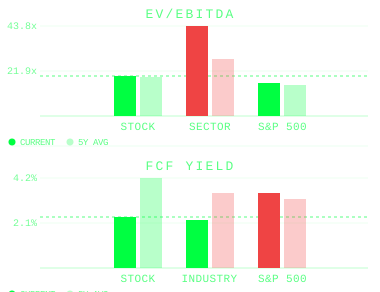
So, is Apple Inc. overvalued? We look at EV/EBITDA and FCF Yield.
EV/EBITDA
Apple Inc. is valued at 19x EV/EBITDA. The sector's historical multiple is also 19x, making this the benchmark for our price target model.
FCF Yield
The current FCF yield is 2.4%, versus the industry average of 2.2%. A higher yield means you are getting more cash flow per dollar invested compared to peers — a positive signal.
Apple's current FCF yield of 2.37% is slightly higher than the industry FCF yield of 2.25%, suggesting it offers a comparable cash flow return relative to its peers. However, given the projected negative FCF growth, this valuation leaves little margin of safety, implying that significant upside may already be priced in.
Verdict
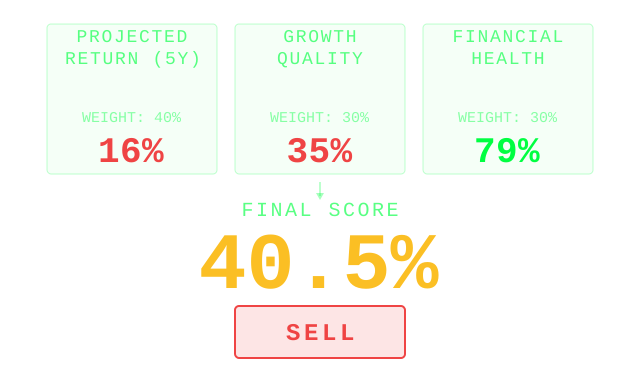
The numbers give Apple Inc. a final score of 40.5/100 — signal: SELL
Apple Inc. is projected to return 0.72x over 5 years, compared to the S&P 500's projected 1.87x over the same period.
The price projection score (16/100) is the limiting factor. While Apple demonstrates accelerating revenue and EBITDA growth, its Free Cash Flow is lagging and its valuation appears stretched, leading to a projected total return multiple of 0.72x including cumulative dividend income of $8.73 per share. This profile suggests the stock may be better suited for long-term holders focused on brand strength and ecosystem rather than those seeking significant capital appreciation or robust cash flow growth in the near term.
→ Full analysis on StockSnack https://stocksnack.app
→ AAPL Full Analysis (Members Only) https://stocksnack.app/screener/AAPL
(Score: price projection 16/100 × 40% · growth quality 35/100 × 30% · financial health 79/100 × 30%)
Want to run the numbers yourself? Every stock in our screener gets the same projection — blending two valuation methods, benchmarked against the S&P 500. Explore all 500 stocks on StockSnack →
Not financial advice. Always do your own research.