AMZN: Amazon's Growth Engine Powers Strong Returns
5 Year Overview
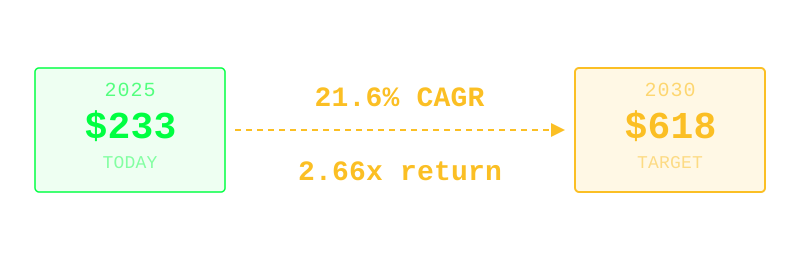
Right now, Amazon.com, Inc. trades at $233. Based on its historical financial performance, the data points to $618 in five years — that is 2.66x, or 21.6% CAGR. The S&P 500 is projected at 1.87x over the same period. That puts it 79% ahead of the S&P 500 over the same period.
Why 2.66x in 5 Years?
EBITDA Method
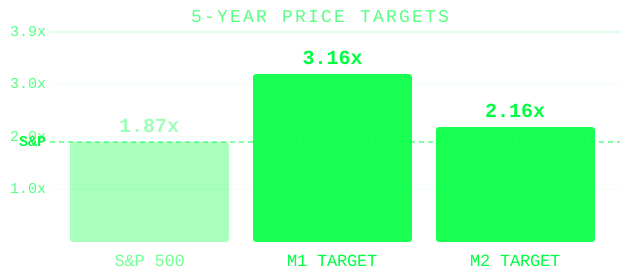
The current EBITDA is $146B and is projected to reach $488B in five years — that is 30% annual growth. Applying the sector's historical multiple of 16x EV/EBITDA gives a price target of $735, or 3.16x from today — ahead of the market.
Amazon's projected return of 3.16x based on EBITDA analysis is higher than the S&P 500's 1.87x, primarily because the company's EBITDA growth rate of 29.63% is significantly faster than the S&P 500's typical ~13%. Amazon's massive scale in e-commerce, cloud computing (AWS), and advertising continues to drive strong operational leverage and expand its profitability. The market values Amazon at 16.16x EV/EBITDA, which is slightly above the S&P 500's average of 15-16x, reflecting Wall Street's confidence in its continued market dominance and future growth prospects.
Free Cash Flow Method
The current free cash flow is $113B and is projected to reach $259B in five years — that is 28% annual growth. With an estimated FCF yield of 4.8%, this gives a price target of $502, or 2.16x from today — ahead of the market.
The FCF-method price target for Amazon beats the S&P 500, with a projected return of 2.16x compared to the S&P 500's 1.87x, because the company generates cash quickly enough with a 28.27% FCF CAGR. Amazon's substantial investments in infrastructure for AWS, fulfillment centers, and new technologies require significant capital expenditure, which can sometimes temper FCF growth, but its operating cash flow generation remains very strong. The current FCF yield of 4.50% is higher than the industry average of 3.80%, indicating that investors are getting a better deal on cash flow per dollar invested compared to its peers.
Blending both methods, the data points to $618 in five years, against today's $233.
Is It Still Growing?
Revenue
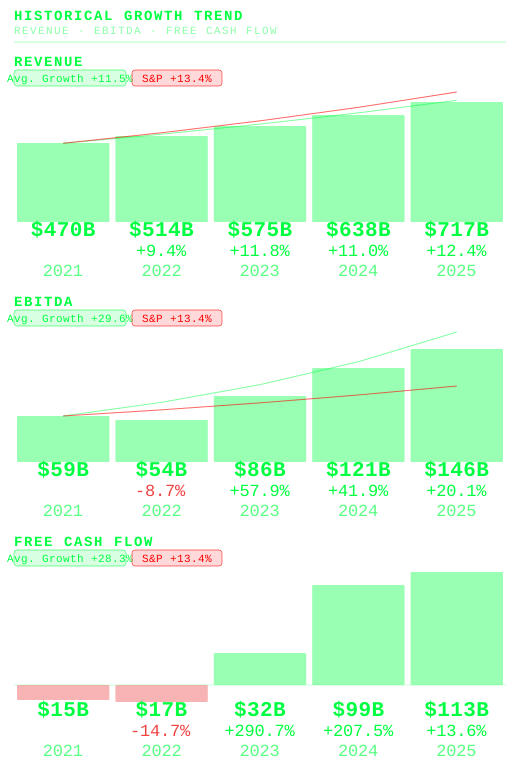
In FY2025, Amazon.com, Inc. brought in $717B in revenue, with a 5-year CAGR of 12%.
Amazon experienced its biggest revenue year-over-year swing in FY2025, with a 12.4% increase. This growth was largely fueled by continued expansion in its core Online Stores segment, which represents $269.29B and 37.6% of total revenue, alongside strong performance in Amazon Web Services (AWS) as cloud adoption continues globally. The company's international expansion and increasing penetration in emerging markets also contributed to this revenue acceleration.
EBITDA
In FY2025, EBITDA came in at $146B, with a 5-year CAGR of 30%.
Amazon's net income saw its biggest year-over-year swing in FY2023, surging by 1,217.7%. This dramatic increase followed a negative net income in FY2022, largely due to a significant gain from its investment in Rivian Automotive, alongside improved operational efficiency. Gross margin expanded from 43.8% in FY2022 to 47.0% in FY2023, and net margin improved from -0.5% to 5.3%, indicating better cost management and pricing power. Revenue grew by 11.8% that year, while EBITDA grew by 57.9%, meaning the company became significantly more efficient and profitable per dollar of revenue.
Free Cash Flow
Free cash flow for FY2025 was $113B, with a 5-year CAGR of 28%.
Amazon's Free Cash Flow saw its biggest year-over-year swing in FY2023, jumping by 290.7%. Operating cash flow rose from $46.75B in FY2022 to $84.95B in FY2023, while capital expenditures decreased from -$63.65B to -$52.73B. This significant FCF improvement was driven by a combination of reduced capital spending after a period of heavy investment in fulfillment and logistics infrastructure, alongside strong operating performance and better working capital management.
Growth Overview
Amazon's revenue growth is accelerating, with a 3-year CAGR of 11.82% compared to its 5-year CAGR of 11.5%. However, EBITDA growth is slowing, with a 3-year CAGR of 53.4% versus its 5-year CAGR of 29.63%, indicating that the rapid post-pandemic surge in profitability is normalizing. EBITDA is growing faster than revenue, meaning the company is getting more profitable per dollar it earns, showing improving efficiency. FCF growth is also slower than EBITDA growth, with a 5-year FCF CAGR of 28.27% compared to EBITDA's 29.63%, which indicates the company is still investing heavily in physical assets and infrastructure. Overall, this is a company running steady with strong underlying profitability, but its most rapid growth acceleration phases are behind it.
Financial Health
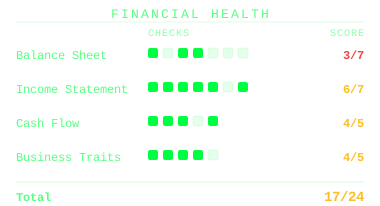
17 out of 24 checks passed.
For the full breakdown, see the detailed analysis on StockSnack:
→ StockSnack Home — https://stocksnack.app
→ AMZN Full Analysis (Pro Only) — https://stocksnack.app/screener/AMZN
What Does Amazon.com, Inc. Actually Do?
Product Breakdown
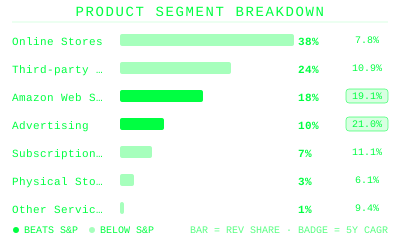 Top 1: Online Stores — 38% of revenue.
This segment represents Amazon's traditional e-commerce business, where it sells products directly to consumers through its websites and mobile apps. It includes sales of electronics, books, apparel, and household goods. This segment generated $269.29B, accounting for 37.6% of total revenue, and its 8% CAGR indicates it is a steady earner that provides a massive foundation for the overall business.
Top 2: Third-party seller services — 24% of revenue.
This segment includes commissions, fulfillment and shipping fees, and other services provided to independent sellers who use Amazon's platform to reach customers. It is a crucial part of Amazon's marketplace model, allowing a vast selection of products. This segment brought in $172.16B, making up 24% of revenue, and its 11% CAGR shows it is a consistent growth engine, benefiting from the expanding e-commerce ecosystem.
Top 3: Amazon Web Services — 18% of revenue.
AWS provides on-demand cloud computing platforms and APIs to individuals, companies, and governments on a metered pay-as-you-go basis. It offers services like computing power, storage, databases, and machine learning. This segment contributed $128.73B, 18% of revenue, and its impressive 19% CAGR makes it Amazon's primary high-growth engine, driving significant profitability and future potential.
Growth by Segment
All Segments by Growth (S&P 500 benchmark: 13% CAGR):
- Advertising: 21% CAGR ✓ — This segment includes sales of display and video advertising, sponsored product ads, and other advertising services to sellers, vendors, publishers, and other third parties. It leverages Amazon's vast customer data and traffic. Generating $68.64B, 9.6% of revenue, its 21% CAGR makes it the fastest-growing segment, highlighting its increasing importance as a revenue and profit driver for the company.
- Amazon Web Services: 19% CAGR ✓ — AWS provides on-demand cloud computing platforms and APIs to individuals, companies, and governments on a metered pay-as-you-go basis. It offers services like computing power, storage, databases, and machine learning. This segment contributed $128.73B, 18% of revenue, and its impressive 19% CAGR makes it Amazon's primary high-growth engine, driving significant profitability and future potential.
- Subscription services: 11% CAGR — This segment includes annual and monthly fees associated with Amazon Prime memberships, which offer benefits like free shipping, streaming video, and music. It also includes digital video, audiobook, digital music, and e-book subscriptions. This segment accounted for $49.62B, 6.9% of revenue, and its 11% CAGR shows it is a stable and growing revenue stream, fostering customer loyalty and ecosystem engagement.
- Third-party seller services: 11% CAGR — This segment includes commissions, fulfillment and shipping fees, and other services provided to independent sellers who use Amazon's platform to reach customers. It is a crucial part of Amazon's marketplace model, allowing a vast selection of products. This segment brought in $172.16B, making up 24% of revenue, and its 11% CAGR shows it is a consistent growth engine, benefiting from the expanding e-commerce ecosystem.
- Other Services Revenue: 9.4% CAGR — This segment captures revenue from various smaller or emerging services not categorized elsewhere, providing flexibility for new ventures and experimental offerings. It includes areas like credit card agreements and other miscellaneous services. This segment contributed $5.94B, 0.8% of revenue, and its 9% CAGR shows it is a small but growing part of Amazon's diverse business portfolio.
- Online Stores: 7.8% CAGR — This segment represents Amazon's traditional e-commerce business, where it sells products directly to consumers through its websites and mobile apps. It includes sales of electronics, books, apparel, and household goods. This segment generated $269.29B, accounting for 37.6% of total revenue, and its 8% CAGR indicates it is a steady earner that provides a massive foundation for the overall business.
- Physical Stores: 6.1% CAGR — This segment includes sales from Amazon's physical retail stores, such as Whole Foods Market, Amazon Go, and Amazon Fresh stores. It represents Amazon's efforts to expand its presence in brick-and-mortar retail. This segment generated $22.56B, 3.1% of revenue, and its 6% CAGR indicates it is a slower-growing area, still finding its footing in a competitive market. On the other end, Physical Stores is the weakest performer at 6.1% CAGR. The Physical Stores segment is the weakest performer with a 6% CAGR, as Amazon continues to navigate the challenges of integrating and scaling its brick-and-mortar retail presence in a highly competitive grocery and convenience store market.
Geographic Performance
UNITED KINGDOM: 13% CAGR · UNITED STATES: 11% CAGR · GERMANY: 11% CAGR
Valuation
So, is Amazon.com, Inc. overvalued? We look at EV/EBITDA and FCF Yield.
EV/EBITDA
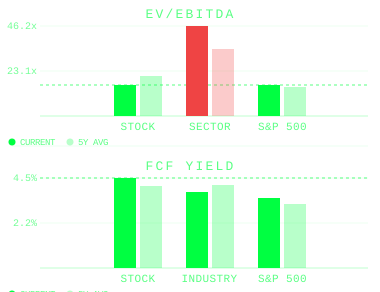
Amazon.com, Inc. is valued at 16x EV/EBITDA. The sector's historical multiple is also 16x, making this the benchmark for our price target model.
FCF Yield
The current FCF yield is 4.5%, versus the industry average of 3.8%. A higher yield means you are getting more cash flow per dollar invested compared to peers — a positive signal.
Amazon's current EV/EBITDA multiple of 16.16x is slightly above the S&P 500's average of 15-16x, indicating the market prices it as a growth stock. Wall Street broadly believes in Amazon's continued leadership in e-commerce and cloud computing, its strong brand, and its significant competitive advantages, which justifies this premium valuation. The FCF yield of 4.50% is higher than the industry average of 3.80%, meaning investors are getting a better deal on the cash flow the company produces per dollar of stock price compared to its peers.
Verdict
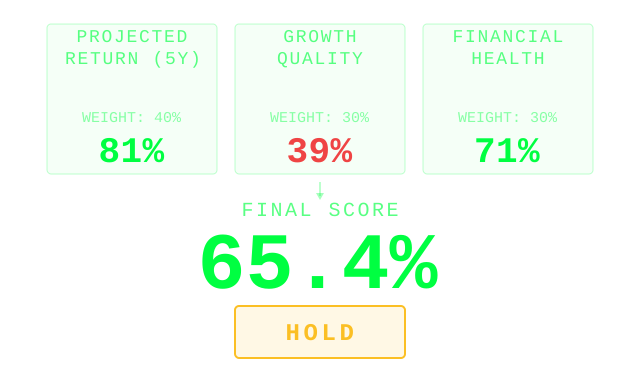
The numbers give Amazon.com, Inc. a final score of 65.4/100 — signal: HOLD
Amazon.com, Inc. is projected to return 2.66x over 5 years, compared to the S&P 500's projected 1.87x over the same period.
The main drag is the growth quality score (39/100) — the business fundamentals have not yet matched the strong price projection. Amazon's projected return of 2.66x beats the S&P 500's 1.87x, indicating a strong potential for outperformance. The company shows accelerating revenue growth but decelerating EBITDA and FCF growth, suggesting a transition from hyper-growth to more sustained, albeit still robust, expansion. Its financial condition is generally strong, with good operational efficiency, though it carries a higher debt-to-equity ratio and lower net margins than some top-tier health benchmarks. The stock is priced at a slight premium to the S&P 500, but its FCF yield is attractive compared to the industry. This stock suits growth-oriented investors who believe in Amazon's long-term dominance in e-commerce and cloud, and who are comfortable with its ongoing investment cycles.
→ Full analysis on StockSnack https://stocksnack.app
→ AMZN Full Analysis (Members Only) https://stocksnack.app/screener/AMZN
(Score: price projection 81/100 × 40% · growth quality 39/100 × 30% · financial health 71/100 × 30%)
Want to run the numbers yourself? Every stock in our screener gets the same projection — blending two valuation methods, benchmarked against the S&P 500. Explore all 500 stocks on StockSnack →
Not financial advice. Always do your own research.