Salesforce (CRM): Growth Slows, But Cash Flow Strong
5 Year Overview
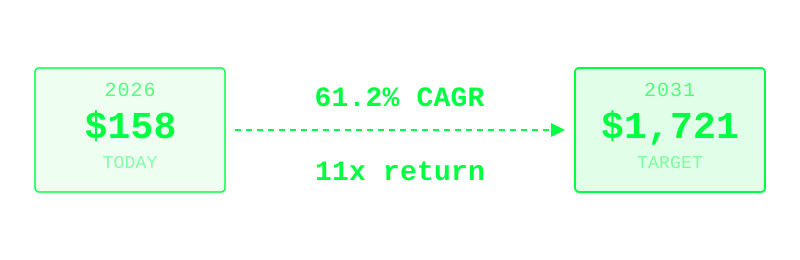
Right now, Salesforce, Inc. trades at $158. Based on its historical financial performance, the data points to $1,721 in five years — that is 10.90x, or 61.2% CAGR. The S&P 500 is projected at 1.87x over the same period. That puts it 903% ahead of the S&P 500 over the same period.
Why 10.90x in 5 Years?
EBITDA Method
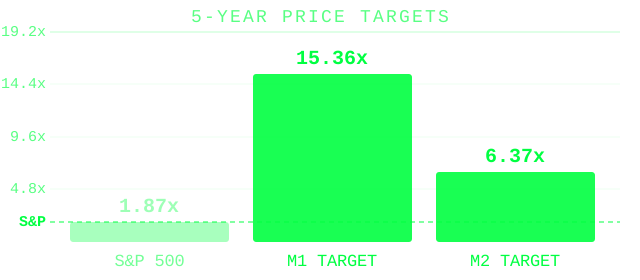
The current EBITDA is $9.53B and is projected to reach $71B in five years — that is 53% annual growth. Applying the sector's historical multiple of 28x EV/EBITDA gives a price target of $2,432, or 15x from today — ahead of the market.
The projected return from the EBITDA method is 15.36x the S&P 500. This is driven by a very fast EBITDA growth rate of 53.4% and a high valuation multiple of 28.3x EV/EBITDA, meaning investors are paying $28.30 for every dollar of EBITDA. Salesforce's strong EBITDA growth comes from its focus on operational efficiency and expanding its high-margin cloud services, especially after recent cost optimization efforts. The market's premium valuation reflects Wall Street's belief in Salesforce's continued leadership in the CRM market and its ability to expand margins.
Free Cash Flow Method
The current free cash flow is $14B and is projected to reach $44B in five years — that is 27% annual growth. With an estimated FCF yield of 5.3%, this gives a price target of $1,009, or 6.37x from today — ahead of the market.
The FCF-method price target beats the S&P 500, primarily because the company generates cash quickly with a 27.26% FCF growth rate and a high FCF yield of 11.10% compared to the industry average of 2.25%. Salesforce's FCF growth is driven by its robust subscription model, which provides predictable cash flows, and its efficient management of capital expenditures. The current FCF yield of 11.10% is significantly higher than the industry average of 2.25%, indicating the stock offers strong cash flow generation relative to its price.
Blending both methods, the data points to $1,721 in five years, against today's $158.
Is It Still Growing?
Revenue
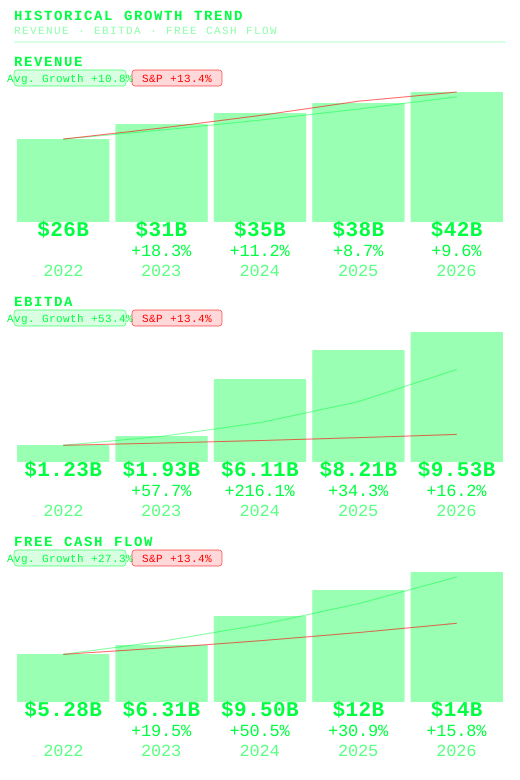
In FY2026, Salesforce, Inc. brought in $42B in revenue, with a 5-year CAGR of 11%.
Salesforce saw its biggest revenue year-over-year swing in FY2023, growing by 18.3%. This growth was driven by strong demand for cloud software and digital transformation initiatives, with the Americas segment contributing $27.193 billion, or 65.5% of total revenue, and growing at an 8% CAGR.
EBITDA
In FY2026, EBITDA came in at $9.53B, with a 5-year CAGR of 53%.
Salesforce experienced its most significant EBITDA year-over-year swing in FY2024, with a remarkable 216.1% increase. This substantial jump was accompanied by expanding margins, with gross margin rising from 73.3% to 75.5% and net margin from 0.7% to 11.9%, reflecting the company's aggressive cost-cutting and efficiency initiatives. EBITDA grew significantly faster than revenue that year, indicating a major improvement in operational efficiency and profitability.
Free Cash Flow
Free cash flow for FY2026 was $14B, with a 5-year CAGR of 27%.
Salesforce saw its largest free cash flow year-over-year swing in FY2024, increasing by 50.5%. Operating cash flow rose from $7.111 billion in FY2023 to $10.234 billion, while capital expenditures remained relatively stable at -$736 million. This strong FCF growth was driven by improved operating efficiency and disciplined capital allocation, as the company focused on converting its subscription revenue into robust cash generation rather than heavy new investments.
Growth Overview
Salesforce's revenue growth is slowing, with a 3-year CAGR of 9.23% compared to its 5-year CAGR of 10.84%, and its EBITDA growth is also decelerating, with a 3-year CAGR of 32.13% versus a 5-year CAGR of 53.4%. EBITDA is growing significantly faster than revenue, meaning the company is becoming more profitable per dollar it earns, indicating improving efficiency. Free cash flow is growing slower than EBITDA, which suggests the company is investing a portion of its operating cash flow back into the business or managing working capital. Overall, this is a company that is improving its profitability and cash generation, even as its top-line growth moderates.
Financial Health
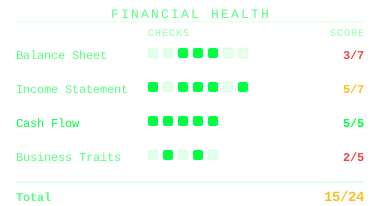
15 out of 24 checks passed.
Salesforce's financial health is mixed, showing strength in some areas but also some notable weaknesses. The "Cash/Debt > 1.0" check failed, meaning the company holds less cash than its total debt, and "Debt/Equity < 80%" also failed, indicating a higher reliance on debt relative to equity. On the positive side, the company consistently passes the "Gross Margin > 40%" check, demonstrating strong core profitability, and "OCF > Net Income" passes, confirming it converts earnings into operating cash effectively. The financial health presents a mixed picture, with strong operational cash generation and gross margins, but also a balance sheet that carries more debt and lower overall profitability metrics.
For the full breakdown, see the detailed analysis on StockSnack:
→ StockSnack Home — https://stocksnack.app
→ CRM Full Analysis (Pro Only) — https://stocksnack.app/screener/CRM
What Does Salesforce, Inc. Actually Do?
Product Breakdown
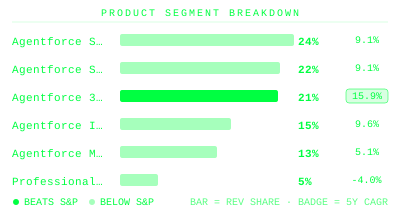 Top 1: Agentforce Service — 24% of revenue.
Top 2: Agentforce Sales — 22% of revenue.
This segment offers sales force automation tools that help businesses manage leads, track opportunities, forecast sales, and automate sales processes to improve efficiency. Generating $9.028 billion, or 21.7% of revenue, its 9% CAGR shows it is another stable core business, providing foundational support for the company's operations.
Top 3: Agentforce 360 Platform, Slack and Other — 21% of revenue.
This segment includes the core Salesforce platform for building custom applications, along with collaboration tools like Slack, enabling businesses to connect data and workflows. With $8.882 billion, or 21.4% of revenue, this segment is a key growth engine, boasting a 16% CAGR as companies increasingly adopt integrated platforms and collaboration tools.
Growth by Segment
All Segments by Growth (S&P 500 benchmark: 13% CAGR):
- Agentforce 360 Platform, Slack and Other: 16% CAGR ✓ — This segment includes the core Salesforce platform for building custom applications, along with collaboration tools like Slack, enabling businesses to connect data and workflows. With $8.882 billion, or 21.4% of revenue, this segment is a key growth engine, boasting a 16% CAGR as companies increasingly adopt integrated platforms and collaboration tools.
- Agentforce Integration And Agentforce: 9.6% CAGR — This segment focuses on integrating various applications and data sources, allowing businesses to connect their systems and automate processes across different software. It contributes $6.232 billion, or 15% of total revenue, and its 10% CAGR shows it is a solid growth area, reflecting the ongoing need for seamless data flow in enterprises.
- Agentforce Sales: 9.1% CAGR — This segment offers sales force automation tools that help businesses manage leads, track opportunities, forecast sales, and automate sales processes to improve efficiency. Generating $9.028 billion, or 21.7% of revenue, its 9% CAGR shows it is another stable core business, providing foundational support for the company's operations.
- Agentforce Service: 9.1% CAGR
- Agentforce Marketing and Agentforce: 5.1% CAGR — This segment provides marketing automation and analytics tools, helping businesses manage customer journeys, personalize campaigns, and measure marketing effectiveness. Representing $5.428 billion, or 13.1% of revenue, its 5% CAGR indicates it is a slower-growing but still significant part of the business, serving a mature market.
- Professional Services and Other: -4.0% CAGR — This segment offers consulting, implementation, and training services to help customers deploy and optimize Salesforce products, ensuring successful adoption and utilization. It accounts for $2.137 billion, or 5.1% of revenue, and its -4% CAGR shows it is a declining area, likely due to customers becoming more self-sufficient or relying on third-party integrators. On the other end, Professional Services and Other is the weakest performer at -4.0% CAGR. The "Professional Services and Other" segment is the weakest performer with a -4% CAGR, as customers increasingly handle implementations themselves or turn to specialized third-party partners.
Geographic Performance
Asia Pacific: 12% CAGR · Europe: 11% CAGR · Americas: 8.1% CAGR
Valuation
So, is Salesforce, Inc. overvalued? We look at EV/EBITDA and FCF Yield.
EV/EBITDA
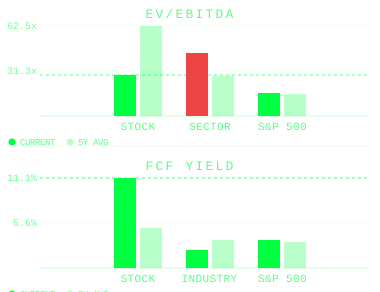
Salesforce, Inc. is valued at 28x EV/EBITDA. The sector's historical multiple is also 28x, making this the benchmark for our price target model.
FCF Yield
The current FCF yield is 11%, versus the industry average of 2.2%. A higher yield means you are getting more cash flow per dollar invested compared to peers — a positive signal.
The current EV/EBITDA multiple is 28.3x, which is significantly higher than the S&P 500 average of 15-16x, indicating the stock is expensive relative to the broader market. Wall Street broadly believes in Salesforce's strong market position, its ability to generate consistent subscription revenue, and its ongoing efforts to expand profitability, justifying this premium valuation. The company's free cash flow yield of 11.10% is much higher than the industry average of 2.25%, meaning investors are getting a very good deal on the cash flow the company produces.
Verdict
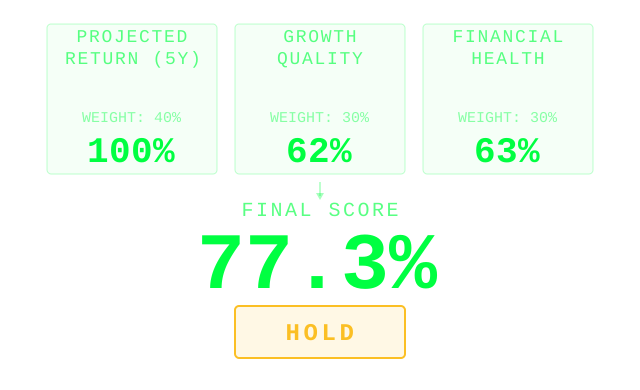
The numbers give Salesforce, Inc. a final score of 77.3/100 — signal: HOLD
Salesforce, Inc. is projected to return 11x over 5 years, compared to the S&P 500's projected 1.87x over the same period.
The projected return for Salesforce is 10.90x the S&P 500, which is a very strong performance, including $5.57 in cumulative dividend income per share over five years. The company's revenue and EBITDA growth are both slowing down, indicating a moderation in its expansion pace. While operational cash flow is robust, the balance sheet shows some concerns with higher debt levels relative to cash and equity. The stock is currently expensive based on its EV/EBITDA multiple, but it offers a very attractive free cash flow yield. This stock suits investors who believe Salesforce can continue to expand its margins and convert its subscription revenue into significant cash flow, despite slowing top-line growth and a premium valuation.
→ Full analysis on StockSnack https://stocksnack.app
→ CRM Full Analysis (Members Only) https://stocksnack.app/screener/CRM
(Score: price projection 100/100 × 40% · growth quality 62/100 × 30% · financial health 63/100 × 30%)
Want to run the numbers yourself? Every stock in our screener gets the same projection — blending two valuation methods, benchmarked against the S&P 500. Explore all 500 stocks on StockSnack →
Not financial advice. Always do your own research.