Coca-Cola (KO): Refreshing Returns or Flat?
5 Year Overview
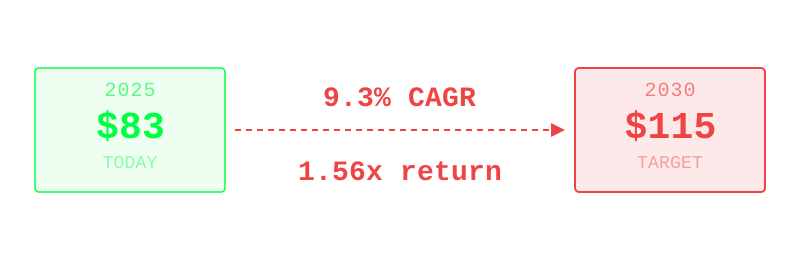
Right now, The Coca-Cola Company trades at $83. Based on its historical financial performance, the data points to $115 in five years — that is 1.56x, or 9.3% CAGR. The S&P 500 is projected at 1.87x over the same period. That puts it 31% behind the S&P 500 over the same period.
Why 1.56x in 5 Years?
EBITDA Method
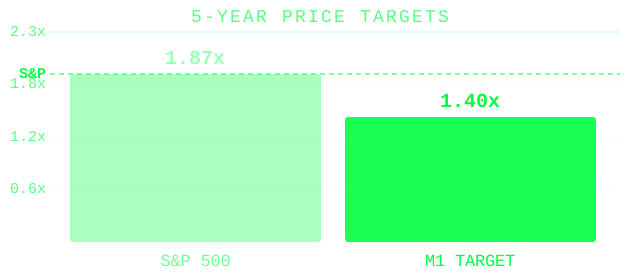
The current EBITDA is $15B and is projected to reach $25B in five years — that is 12% annual growth. Applying the sector's historical multiple of 21x EV/EBITDA gives a price target of $115, or 1.40x from today — behind the market.
Coca-Cola's projected return of 1.56x is lower than the S&P 500's 1.87x. This is mainly because the stock trades at 21.41x EV/EBITDA, meaning investors are paying $21.41 for every dollar of EBITDA, which is high compared to the S&P 500's typical 15-16x. Coca-Cola's EBITDA growth of 11.5% is driven by its strong global brand presence and strategic price increases, even as it navigates diverse international markets and currency fluctuations. The market's valuation premium reflects Wall Street's confidence in Coca-Cola's consistent cash generation and its defensive consumer staple status.
Blending both methods, the data points to $115 in five years, against today's $83.
Is It Still Growing?
Revenue
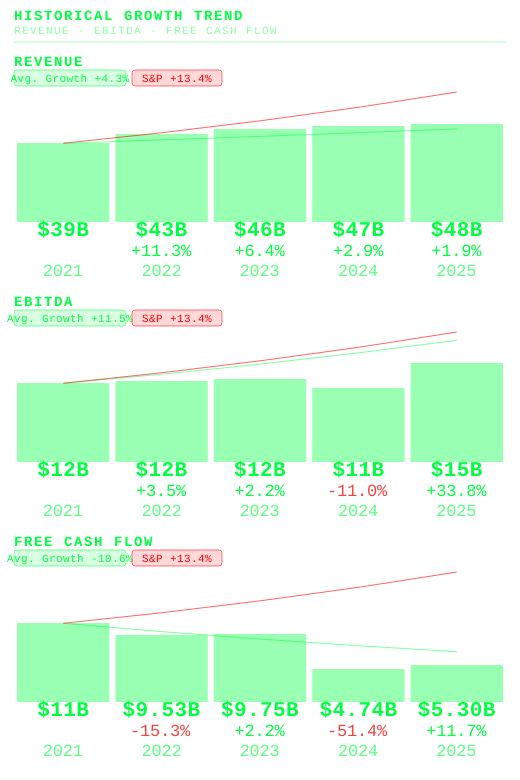
In FY2025, The Coca-Cola Company brought in $48B in revenue, with a 5-year CAGR of 4.3%.
Coca-Cola's biggest revenue year-over-year swing was an 11.3% increase in FY2022. This growth was driven by strong performance in its UNITED STATES geographic segment, which grew at an 8% CAGR, alongside robust demand for its core Concentrate operations.
EBITDA
In FY2025, EBITDA came in at $15B, with a 5-year CAGR of 12%.
The biggest EBITDA swing was a 33.8% increase in FY2025. Gross margin expanded from 61.1% in FY2024 to 61.6% in FY2025, and net margin increased from 22.6% to 27.4%, reflecting effective cost management and pricing power. In FY2025, EBITDA grew significantly faster at 33.8% compared to revenue growth of 1.9%, indicating the company became much more efficient at converting sales into operating profit.
Free Cash Flow
Free cash flow for FY2025 was $5.30B, with a 5-year CAGR of -11%.
The biggest FCF swing was a -51.4% decline in FY2024. Operating cash flow decreased from $11.6B in FY2023 to $6.8B in FY2024, while capital expenditures increased from -$1.85B to -$2.06B. This significant drop was due to a substantial decrease in operating cash flow, likely influenced by changes in working capital and increased investments in its global supply chain and bottling partners.
Growth Overview
Coca-Cola's revenue growth is slowing, with a 3-year CAGR of 2.26% compared to a 5-year CAGR of 4.29%. However, EBITDA growth is accelerating, showing a 3-year CAGR of 13.78% versus a 5-year CAGR of 11.5%. EBITDA is growing faster than revenue, which means the company is getting more profitable per dollar it earns, indicating improving efficiency. FCF growth is significantly slower than EBITDA growth, with FCF declining at a 10.61% 5-year CAGR while EBITDA grows at 11.5%. This gap shows the company is spending a lot on physical assets and working capital, consuming cash. Overall, Coca-Cola is a company with slowing top-line growth but improving profitability, though its cash generation is under pressure from investments.
Financial Health
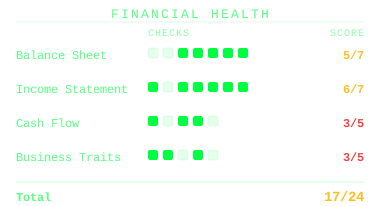
17 out of 24 checks passed.
For the full breakdown, see the detailed analysis on StockSnack:
→ StockSnack Home — https://stocksnack.app
→ KO Full Analysis (Pro Only) — https://stocksnack.app/screener/KO
What Does The Coca-Cola Company Actually Do?
Product Breakdown
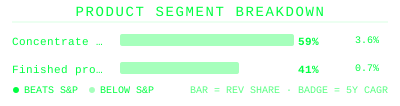 Top 1: Concentrate operations — 59% of revenue.
Top 2: Finished product operations — 41% of revenue.
This segment includes the company's own bottling and distribution operations, where Coca-Cola directly manufactures, sells, and distributes finished beverages to customers. This often happens in markets where the company has a direct ownership stake in bottling plants. It accounts for $19.48B or 40.6% of total revenue and has grown at a 1% CAGR, indicating it is a slower-growing but stable part of the business.
Growth by Segment
All Segments by Growth (S&P 500 benchmark: 13% CAGR):
- Concentrate operations: 3.6% CAGR
- Finished product operations: 0.7% CAGR — This segment includes the company's own bottling and distribution operations, where Coca-Cola directly manufactures, sells, and distributes finished beverages to customers. This often happens in markets where the company has a direct ownership stake in bottling plants. It accounts for $19.48B or 40.6% of total revenue and has grown at a 1% CAGR, indicating it is a slower-growing but stable part of the business. On the other end, Finished product operations is the weakest performer at 0.7% CAGR. The Non-US geographic segment is the weakest performer, with a -1% CAGR, reflecting challenges in certain international markets and currency headwinds.
Geographic Performance
UNITED STATES: 7.5% CAGR · Non-US: -0.7% CAGR
Valuation
So, is The Coca-Cola Company overvalued? We look at EV/EBITDA and FCF Yield.
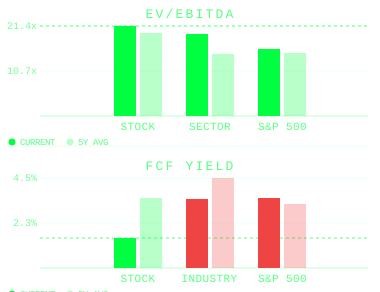
EV/EBITDA
The Coca-Cola Company is valued at 21x EV/EBITDA. The sector's historical multiple is also 21x, making this the benchmark for our price target model.
FCF Yield
The current FCF yield is 1.5%, versus the industry average of 3.5%. Yield below peers suggests the market is pricing in stronger future growth.
Coca-Cola trades at an EV/EBITDA multiple of 21.41x, which is expensive relative to the S&P 500's typical 15-16x. Wall Street broadly believes Coca-Cola's strong brand, global distribution, and consistent dividend payments justify this premium, viewing it as a stable, defensive investment. The FCF yield of 1.49% is significantly lower than the industry average of 3.46%, meaning investors are getting a less attractive cash flow return per dollar invested compared to peers.
Verdict
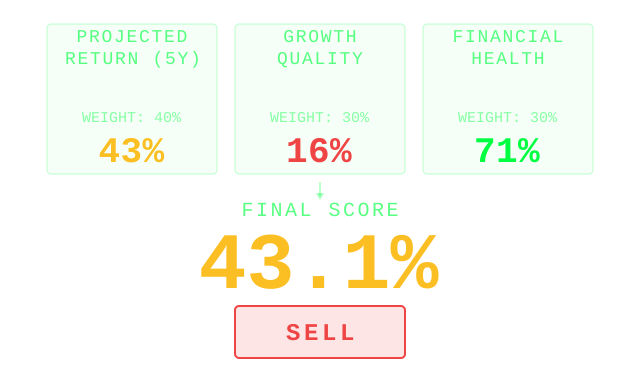
The numbers give The Coca-Cola Company a final score of 43.1/100 — signal: SELL
The Coca-Cola Company is projected to return 1.56x over 5 years, compared to the S&P 500's projected 1.87x over the same period.
The main drag is the growth quality score (16/100) — the business fundamentals have not yet matched the strong price projection. Coca-Cola's projected return of 1.56x falls short of the S&P 500's 1.87x. The company shows slowing revenue growth but accelerating EBITDA growth, indicating improved profitability despite top-line challenges. Its financial health is mixed, with concerns around debt levels and cash flow generation efficiency. The stock is expensive, trading at a premium EV/EBITDA multiple and offering a low FCF yield compared to the industry. This stock suits investors prioritizing stable brands and dividends, but it requires a belief that Coca-Cola can sustain profitability improvements and overcome cash flow pressures for it to be a good investment. The cumulative dividend income over five years was $13.63 per share, contributing to a total return multiple of 1.56x.
→ Full analysis on StockSnack https://stocksnack.app
→ KO Full Analysis (Members Only) https://stocksnack.app/screener/KO
(Score: price projection 43/100 × 40% · growth quality 16/100 × 30% · financial health 71/100 × 30%)
Want to run the numbers yourself? Every stock in our screener gets the same projection — blending two valuation methods, benchmarked against the S&P 500. Explore all 500 stocks on StockSnack →
Not financial advice. Always do your own research.