META: Strong Ad Growth, High Investment Costs
5 Year Overview
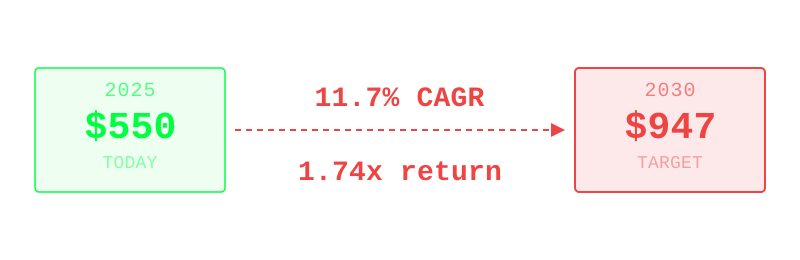
Right now, Meta Platforms, Inc. trades at $550. Based on its historical financial performance, the data points to $947 in five years — that is 1.74x, or 11.7% CAGR. The S&P 500 is projected at 1.87x over the same period. That puts it 13% behind the S&P 500 over the same period.
Why 1.74x in 5 Years?
EBITDA Method
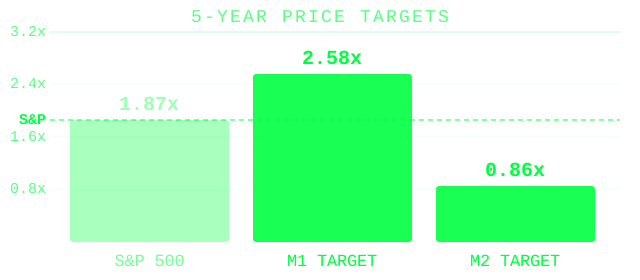
The current EBITDA is $102B and is projected to reach $251B in five years — that is 21% annual growth. Applying the sector's historical multiple of 14x EV/EBITDA gives a price target of $1,420, or 2.58x from today — ahead of the market.
Meta's projected return of 2.58x based on EBITDA analysis is higher than the S&P 500's 1.87x, primarily because its EBITDA growth rate of 21.38% is fast compared to the S&P 500's typical ~13%. This strong growth is driven by Meta's dominant position in digital advertising, effective monetization of its Family of Apps, and strategic investments in AI that enhance ad targeting and user engagement. The market's current valuation of 14.45x EV/EBITDA, where investors pay $14.45 for every dollar of EBITDA, is justified by Wall Street's confidence in Meta's core ad business and its ability to expand margins through efficiency initiatives.
Free Cash Flow Method
The current free cash flow is $46B and is projected to reach $51B in five years — that is 19% annual growth. With an estimated FCF yield of 4.2%, this gives a price target of $475, or 0.86x from today — behind the market.
The FCF-method price target of 0.86x trails the S&P 500's 1.87x, mainly because the company's free cash flow (FCF) growth rate is a very slow 2.25%. This slow FCF growth is due to Meta's substantial capital expenditures, which reached -$69.69B in FY2025, reflecting heavy investments in data centers and AI infrastructure. The current FCF yield of 3.30% is higher than the industry average of 2.92%, meaning the company produces more cash per dollar you invest compared to its peers.
Blending both methods, the data points to $947 in five years, against today's $550.
Is It Still Growing?
Revenue
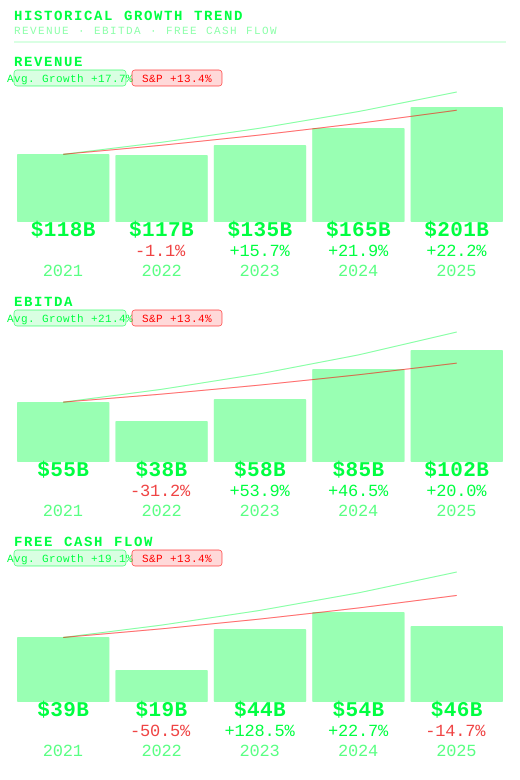
In FY2025, Meta Platforms, Inc. brought in $201B in revenue, with a 5-year CAGR of 18%.
Meta experienced its biggest revenue year-over-year swing in FY2025, with a 22.2% increase. This surge was primarily driven by robust growth in its Family of Apps segment, which generated $198.76B and accounts for 98.9% of total revenue, as the company continued to improve ad targeting and monetization across Facebook, Instagram, and WhatsApp. The strong performance in the US & Canada and Asia Pacific regions, both with 22% CAGRs, also fueled this revenue expansion.
EBITDA
In FY2025, EBITDA came in at $102B, with a 5-year CAGR of 21%.
The biggest net income swing occurred in FY2023, with a significant 68.5% increase year-over-year. This dramatic improvement was a direct result of Meta's 'Year of Efficiency' initiatives, which involved substantial cost-cutting and a more disciplined approach to expenses, leading to an expansion of the gross margin from 78.3% in FY2022 to 80.8% in FY2023, and net margin from 19.9% to 29.0%. Net income grew much faster than revenue in FY2023, indicating the company became significantly more efficient and profitable per dollar earned.
Free Cash Flow
Free cash flow for FY2025 was $46B, with a 5-year CAGR of 19%.
Meta's free cash flow saw its biggest year-over-year swing in FY2023, with a remarkable 128.5% increase. This was driven by operating cash flow rising from $50.48B in FY2022 to $71.11B in FY2023, while capital expenditures decreased from -$31.19B to -$27.05B. The business reason for this was a period of optimization in capital spending following heavy investments in prior years, coupled with improved operational efficiency and a focus on core profitability.
Growth Overview
Meta's revenue growth is accelerating, with a 3-year CAGR of 22.08% compared to its 5-year CAGR of 17.71%. Similarly, EBITDA growth is also accelerating, showing a 3-year CAGR of 21.97% against a 5-year CAGR of 21.38%. EBITDA is growing faster than revenue, meaning the company is getting more profitable per dollar it earns, indicating improving efficiency. However, free cash flow growth is significantly slower than EBITDA growth, with a 5-year FCF CAGR of 19.12% compared to a 3-year FCF CAGR of 0.24%, indicating substantial cash consumption for capital expenditures. Overall, this is a company picking up speed in its core business but facing significant cash outflows for future investments.
Financial Health
17 out of 24 checks passed.
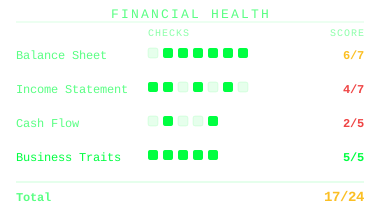
For the full breakdown, see the detailed analysis on StockSnack:
→ StockSnack Home — https://stocksnack.app
→ META Full Analysis (Pro Only) — https://stocksnack.app/screener/META
What Does Meta Platforms, Inc. Actually Do?
Product Breakdown
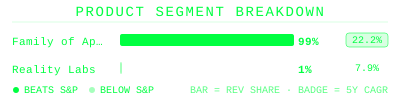 Top 1: Family of Apps — 99% of revenue.
This segment includes Facebook, Instagram, Messenger, and WhatsApp, which are social media and messaging platforms where Meta generates revenue primarily through advertising. These platforms connect billions of users globally, allowing businesses to reach target audiences with personalized ads. This segment generated $198.76B, representing 98.9% of total revenue, and has a strong 22% CAGR, making it the primary growth engine and profit driver for the entire company.
Top 2: Reality Labs — 1.10% of revenue.
This segment is responsible for Meta's hardware, software, and content related to augmented and virtual reality, including products like the Quest VR headsets and ongoing development of the metaverse. It represents Meta's long-term bet on immersive digital experiences. This segment generated $2.21B, accounting for 1.1% of total revenue, and has an 8% CAGR, indicating it is a nascent area requiring significant investment with slower growth compared to the core business.
Growth by Segment
All Segments by Growth (S&P 500 benchmark: 13% CAGR):
- Family of Apps: 22% CAGR ✓ — This segment includes Facebook, Instagram, Messenger, and WhatsApp, which are social media and messaging platforms where Meta generates revenue primarily through advertising. These platforms connect billions of users globally, allowing businesses to reach target audiences with personalized ads. This segment generated $198.76B, representing 98.9% of total revenue, and has a strong 22% CAGR, making it the primary growth engine and profit driver for the entire company.
- Reality Labs: 7.9% CAGR — This segment is responsible for Meta's hardware, software, and content related to augmented and virtual reality, including products like the Quest VR headsets and ongoing development of the metaverse. It represents Meta's long-term bet on immersive digital experiences. This segment generated $2.21B, accounting for 1.1% of total revenue, and has an 8% CAGR, indicating it is a nascent area requiring significant investment with slower growth compared to the core business. On the other end, Reality Labs is the weakest performer at 7.9% CAGR. The Reality Labs segment is the weakest performer with an 8% CAGR, primarily due to the nascent stage of the metaverse market and the substantial, ongoing investment required for hardware and software development without widespread consumer adoption yet.
Geographic Performance
Europe: 22% CAGR · US & Canada: 22% CAGR · Asia Pacific: 22% CAGR
Valuation
So, is Meta Platforms, Inc. overvalued? We look at EV/EBITDA and FCF Yield.
EV/EBITDA
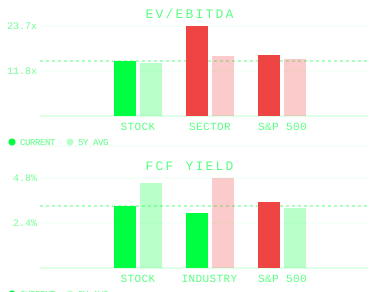
Meta Platforms, Inc. is valued at 14x EV/EBITDA. The sector's historical multiple is also 14x, making this the benchmark for our price target model.
FCF Yield
The current FCF yield is 3.3%, versus the industry average of 2.9%. A higher yield means you are getting more cash flow per dollar invested compared to peers — a positive signal.
Meta's current EV/EBITDA multiple is 14.45x, which is slightly lower than the S&P 500's typical range of 15-16x, suggesting it is priced reasonably relative to the broader market. Wall Street broadly believes in Meta's strong competitive advantage in digital advertising and its ability to generate significant profits, which justifies its current multiple despite heavy investments in Reality Labs. The company's FCF yield of 3.30% is higher than the industry average of 2.92%, meaning investors are getting a better deal on the cash flow the company produces per dollar invested compared to its peers.
Verdict
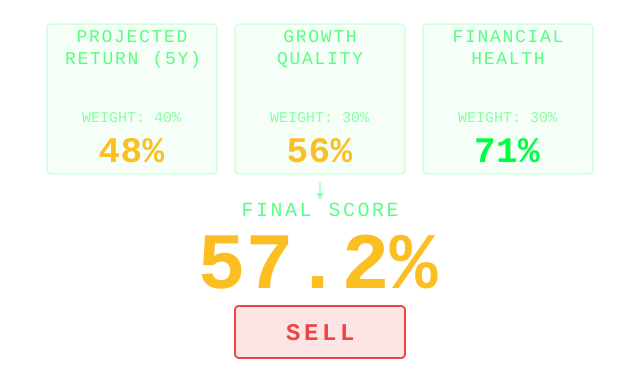
The numbers give Meta Platforms, Inc. a final score of 57.2/100 — signal: SELL
Meta Platforms, Inc. is projected to return 1.74x over 5 years, compared to the S&P 500's projected 1.87x over the same period.
The price projection score (48/100) is the limiting factor. Meta's projected return of 2.58x based on EBITDA analysis beats the S&P 500's 1.87x, indicating a strong outlook. The company shows accelerating revenue and EBITDA growth, signaling increasing momentum in its core business. While its balance sheet has some red flags due to high capital expenditures, its core profitability and debt management remain strong. On a valuation basis, the stock appears reasonably priced on an EV/EBITDA basis and offers a better FCF yield than the industry average. This stock is for investors who believe in the long-term potential of Meta's AI and metaverse investments, and who are comfortable with the associated high capital spending, while benefiting from its dominant and highly profitable advertising business. The company also provided $9.76 in cumulative dividend income per share over the last five years, contributing to its total return multiple of 1.74x.
→ Full analysis on StockSnack https://stocksnack.app
→ META Full Analysis (Members Only) https://stocksnack.app/screener/META
(Score: price projection 48/100 × 40% · growth quality 56/100 × 30% · financial health 71/100 × 30%)
Want to run the numbers yourself? Every stock in our screener gets the same projection — blending two valuation methods, benchmarked against the S&P 500. Explore all 500 stocks on StockSnack →
Not financial advice. Always do your own research.