Microsoft (MSFT): Cloud Powerhouse with Strong Growth
5 Year Overview
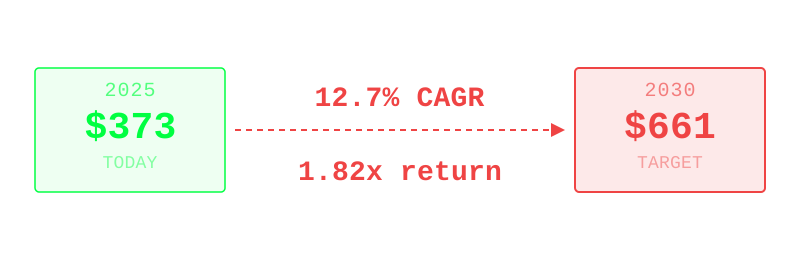
Right now, Microsoft Corporation trades at $373. Based on its historical financial performance, the data points to $661 in five years — that is 1.82x, or 12.7% CAGR. The S&P 500 is projected at 1.87x over the same period. That puts it 5% behind the S&P 500 over the same period.
Why 1.82x in 5 Years?
EBITDA Method
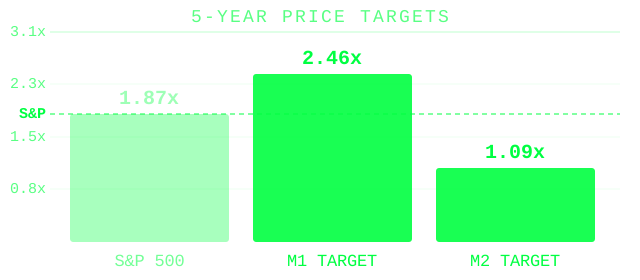
The current EBITDA is $151B and is projected to reach $332B in five years — that is 19% annual growth. Applying the sector's historical multiple of 20x EV/EBITDA gives a price target of $917, or 2.46x from today — ahead of the market.
Microsoft's projected return using the EBITDA method is higher than the S&P 500, driven by its fast EBITDA growth rate of 18.6%. Microsoft's EBITDA growth is fueled by its dominant position in cloud computing (Azure) and enterprise software, which command strong pricing power and recurring revenue. The market's premium valuation of 20.34x EV/EBITDA reflects Wall Street's strong confidence in Microsoft's continued innovation and market leadership in high-growth areas like AI and cloud services.
Free Cash Flow Method
The current free cash flow is $72B and is projected to reach $92B in five years — that is 5.6% annual growth. With an estimated FCF yield of 3.1%, this gives a price target of $405, or 1.09x from today — behind the market.
The FCF-method price target for Microsoft trails the S&P 500, primarily because its free cash flow growth rate is 5.62%. Microsoft's significant investments in data centers and cloud infrastructure, reflected in its high capital expenditures, consume a substantial portion of its operating cash flow, limiting FCF growth. The current free cash flow yield of 2.58% is slightly higher than the industry average of 2.25%, indicating the company produces a reasonable amount of cash per dollar invested compared to its peers.
Blending both methods, the data points to $661 in five years, against today's $373.
Is It Still Growing?
Revenue
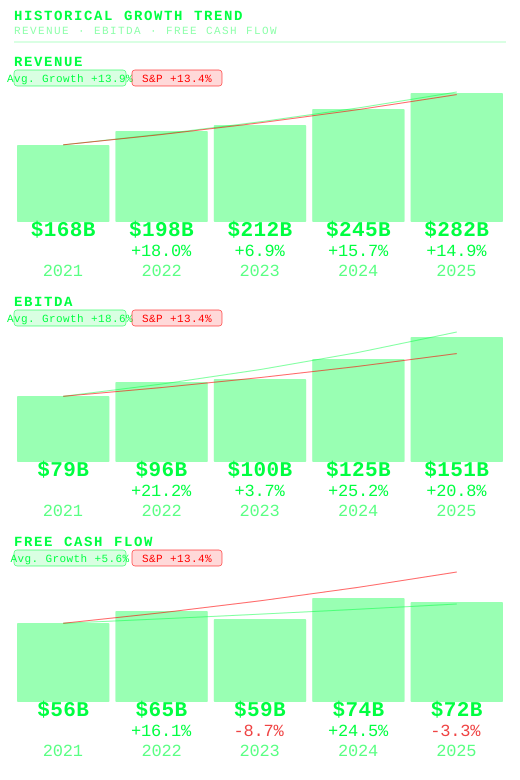
In FY2025, Microsoft Corporation brought in $282B in revenue, with a 5-year CAGR of 14%.
Microsoft's biggest revenue year-over-year swing was in fiscal year 2022, with an 18.0% increase. This growth was largely driven by strong demand for Server Products And Cloud Services, which grew to $98.44B and represented 34.9% of total revenue, as businesses accelerated their digital transformation initiatives.
EBITDA
In FY2025, EBITDA came in at $151B, with a 5-year CAGR of 19%.
The largest EBITDA swing occurred in fiscal year 2024, with a significant 25.2% increase. Gross margin expanded from 68.9% in FY2023 to 69.8% in FY2024, and net margin also improved from 34.1% to 36.0%, reflecting improved cost efficiencies and a favorable product mix towards higher-margin cloud services. In FY2024, EBITDA grew faster at 25.2% compared to revenue growth of 15.7%, indicating the company became more efficient at converting sales into operating profit.
Free Cash Flow
Free cash flow for FY2025 was $72B, with a 5-year CAGR of 5.6%.
Microsoft's free cash flow saw its largest swing in fiscal year 2024, increasing by 24.5%. Operating cash flow rose from $87.58B in FY2023 to $118.55B in FY2024, while capital expenditures also increased significantly from -$28.11B to -$44.48B. This strong FCF growth was driven by robust operating performance, even as the company continued heavy investments in its cloud infrastructure to meet surging demand for Azure services.
Growth Overview
Revenue growth is accelerating, with the 3-year CAGR at 15.23% compared to the 5-year CAGR of 13.92%, while EBITDA growth is slowing, with the 3-year CAGR at 18.04% versus the 5-year CAGR of 18.6%. EBITDA is growing faster than revenue (18.6% vs 13.92%), which means the company is becoming more profitable per dollar it earns, indicating improving efficiency. Free cash flow growth (5.62%) is significantly slower than EBITDA growth (18.6%), indicating the company is spending a lot on physical assets like data centers to support its cloud expansion. This is a company with strong underlying profitability, but its heavy investments are consuming a large portion of its cash flow, even as revenue growth picks up speed.
Financial Health
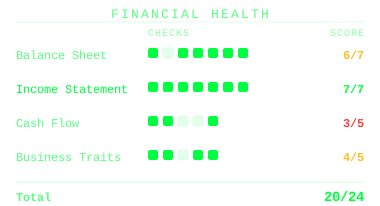
20 out of 24 checks passed.
For the full breakdown, see the detailed analysis on StockSnack:
→ StockSnack Home — https://stocksnack.app
→ MSFT Full Analysis (Pro Only) — https://stocksnack.app/screener/MSFT
What Does Microsoft Corporation Actually Do?
Product Breakdown
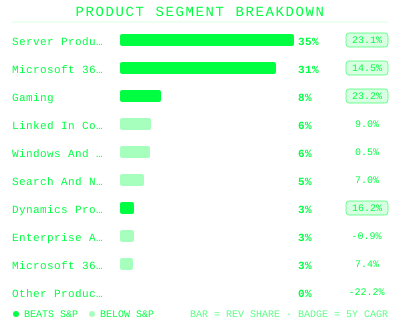 Top 1: Server Products And Cloud Services — 35% of revenue.
This segment provides server software, cloud services like Azure, and enterprise services to businesses and developers worldwide, forming the backbone of modern digital operations. Generating $98.44B, or 34.9% of total revenue, this segment is a major growth engine for Microsoft, expanding at a 23% CAGR.
Top 2: Microsoft 365 Commercial Products and Cloud Services — 31% of revenue.
This segment offers productivity and collaboration tools such as Office 365, Teams, and related cloud services to businesses, helping them manage their daily operations and communication. With $87.77B in revenue, representing 31.2% of the total, this is a steady earner growing at a 14% CAGR, providing consistent recurring income.
Top 3: Gaming — 8.30% of revenue.
This segment includes Xbox hardware, games, Game Pass subscriptions, and content from ZeniMax and Activision Blizzard, targeting consumers who play video games. Contributing $23.45B, or 8.3% of revenue, Gaming is a significant growth area for Microsoft, expanding rapidly at a 23% CAGR.
Growth by Segment
All Segments by Growth (S&P 500 benchmark: 13% CAGR):
- Gaming: 23% CAGR ✓ — This segment includes Xbox hardware, games, Game Pass subscriptions, and content from ZeniMax and Activision Blizzard, targeting consumers who play video games. Contributing $23.45B, or 8.3% of revenue, Gaming is a significant growth area for Microsoft, expanding rapidly at a 23% CAGR.
- Server Products And Cloud Services: 23% CAGR ✓ — This segment provides server software, cloud services like Azure, and enterprise services to businesses and developers worldwide, forming the backbone of modern digital operations. Generating $98.44B, or 34.9% of total revenue, this segment is a major growth engine for Microsoft, expanding at a 23% CAGR.
- Dynamics Products And Cloud Services: 16% CAGR ✓ — This segment offers enterprise resource planning (ERP) and customer relationship management (CRM) business applications, helping organizations manage their operations and customer interactions. Generating $7.83B, or 2.8% of revenue, this segment is a growth engine for Microsoft, expanding at a 16% CAGR.
- Microsoft 365 Commercial Products and Cloud Services: 14% CAGR ✓ — This segment offers productivity and collaboration tools such as Office 365, Teams, and related cloud services to businesses, helping them manage their daily operations and communication. With $87.77B in revenue, representing 31.2% of the total, this is a steady earner growing at a 14% CAGR, providing consistent recurring income.
- Linked In Corporation: 9.0% CAGR — This segment operates the professional social network LinkedIn, offering services like talent solutions, marketing solutions, and premium subscriptions to professionals and businesses. It generates $17.81B, or 6.3% of revenue, and is a steady earner growing at a 9% CAGR, leveraging its unique professional network.
- Microsoft 365 Consumer Products and Cloud Services: 7.4% CAGR — This segment offers consumer versions of Office 365, OneDrive, and other cloud services, targeting individual users and households. Contributing $7.4B, or 2.6% of revenue, this segment is a steady earner growing at a 7% CAGR.
- Search And News Advertising: 7.0% CAGR — This segment provides advertising services on Microsoft's search engine (Bing) and news properties, targeting advertisers looking to reach online audiences. With $13.88B in revenue, or 4.9% of the total, this segment is a steady earner growing at a 7% CAGR.
- Windows And Devices: 0.5% CAGR — This segment includes Windows operating system licenses for PCs, Surface devices, and PC accessories, serving both consumers and businesses. Accounting for $17.31B, or 6.1% of revenue, this segment shows stable performance with a 0% CAGR, indicating a mature market.
- Enterprise And Partner Services: -0.9% CAGR — This segment provides consulting, product support, and other services to enterprise customers and partners, helping them implement and optimize Microsoft technologies. With $7.76B in revenue, or 2.8% of the total, this is a declining area for Microsoft, showing a -1% CAGR.
- Other Products And Services: -22% CAGR — This segment includes various other products and services not categorized elsewhere, representing a small portion of Microsoft's diverse offerings. With $72M in revenue, this segment is a declining area for Microsoft, showing a -22% CAGR. On the other end, Other Products And Services is the weakest performer at -22% CAGR. The weakest-performing segment is Enterprise And Partner Services, with a -1% CAGR, as businesses increasingly adopt self-service cloud solutions and rely less on traditional consulting and support services.
Geographic Performance
US: 16% CAGR · Non-US: 14% CAGR
Valuation
So, is Microsoft Corporation overvalued? We look at EV/EBITDA and FCF Yield.
EV/EBITDA
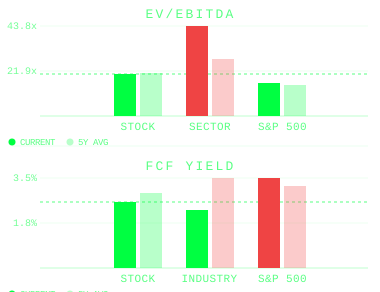
Microsoft Corporation is valued at 20x EV/EBITDA. The sector's historical multiple is also 20x, making this the benchmark for our price target model.
FCF Yield
The current FCF yield is 2.6%, versus the industry average of 2.2%. A higher yield means you are getting more cash flow per dollar invested compared to peers — a positive signal.
Microsoft currently trades at 20.34x EV/EBITDA, which is expensive relative to the S&P 500 average of around 15-16x. Wall Street broadly believes Microsoft's strong brand, dominant market position in cloud computing, and significant investments in AI justify this premium, expecting continued high growth and profitability. The current free cash flow yield of 2.58% is slightly higher than the industry average of 2.25%, meaning investors are getting a reasonable return on cash flow compared to peers.
Verdict
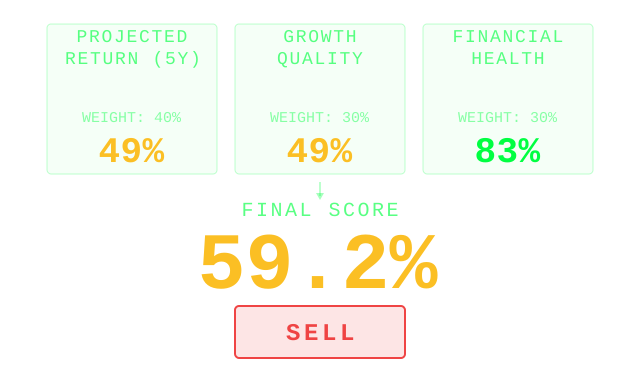
The numbers give Microsoft Corporation a final score of 59.2/100 — signal: SELL
Microsoft Corporation is projected to return 1.82x over 5 years, compared to the S&P 500's projected 1.87x over the same period.
The price projection score (49/100) is the limiting factor. Microsoft's projected total return of 82% falls slightly short of the S&P 500's expected performance over the next five years. The company shows solid overall growth, with revenue accelerating, though EBITDA growth has slightly slowed. Its financial health is generally strong, but high debt-to-equity and significant capital expenditures are areas of concern. The stock is currently expensive, trading at a premium compared to the broader market. This stock suits investors who prioritize long-term growth in cloud and AI, are comfortable with a premium valuation, and appreciate the cumulative dividend income of $16.65 per share over five years; continued innovation and market dominance are crucial for its future performance.
→ Full analysis on StockSnack https://stocksnack.app
→ MSFT Full Analysis (Members Only) https://stocksnack.app/screener/MSFT
(Score: price projection 49/100 × 40% · growth quality 49/100 × 30% · financial health 83/100 × 30%)
Want to run the numbers yourself? Every stock in our screener gets the same projection — blending two valuation methods, benchmarked against the S&P 500. Explore all 500 stocks on StockSnack →
Not financial advice. Always do your own research.