NVIDIA (NVDA): AI Powerhouse with 6.99x S&P 500 Return
5 Year Overview
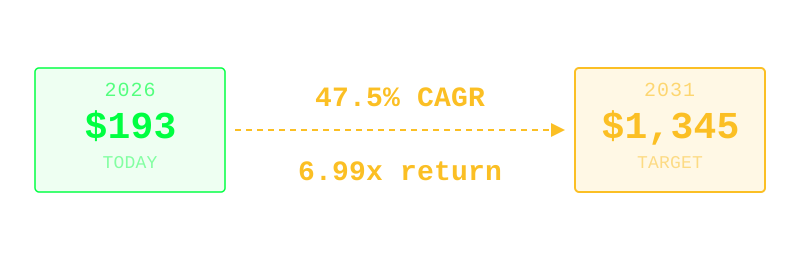
Right now, NVIDIA Corporation trades at $193. Based on its historical financial performance, the data points to $1,345 in five years — that is 6.99x, or 47.5% CAGR. The S&P 500 is projected at 1.87x over the same period. That puts it 512% ahead of the S&P 500 over the same period.
Why 6.99x in 5 Years?
EBITDA Method
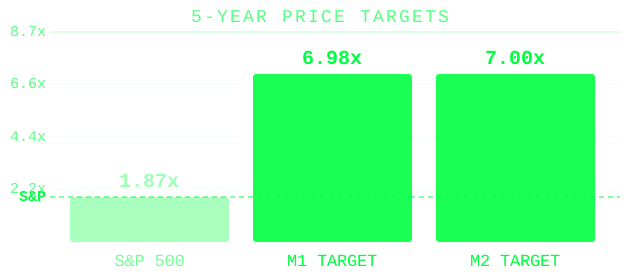
The current EBITDA is $133B and is projected to reach $987B in five years — that is 53% annual growth. Applying the sector's historical multiple of 33x EV/EBITDA gives a price target of $1,344, or 6.98x from today — ahead of the market.
NVIDIA's projected return is significantly higher than the S&P 500's. This is because the company's EBITDA growth rate of 53.4% is much faster than the S&P 500's typical 13.35%. The massive demand for AI infrastructure, driven by large language models and data center expansion, fuels this rapid EBITDA growth. The market's valuation of 32.96x EV/EBITDA, which is high compared to the S&P 500's ~15-16x, reflects Wall Street's strong belief in NVIDIA's continued dominance in AI.
Free Cash Flow Method
The current free cash flow is $102B and is projected to reach $755B in five years — that is 53% annual growth. With an estimated FCF yield of 2.3%, this gives a price target of $1,347, or 7.00x from today — ahead of the market.
The FCF-method price target for NVIDIA beats the S&P 500. The company generates cash quickly, with a FCF growth rate of 53.4%. NVIDIA's strong FCF generation comes from its high-margin chip sales and efficient operations, despite significant R&D investments in new technologies. The current FCF yield of 2.19% is slightly below the industry average of 2.25%, indicating the stock is priced for future growth rather than offering a high immediate cash return.
Blending both methods, the data points to $1,345 in five years, against today's $193.
Is It Still Growing?
Revenue
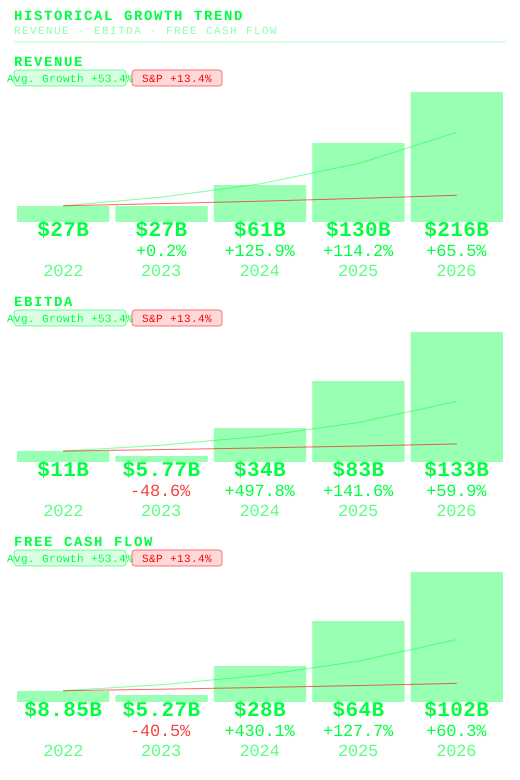
In FY2026, NVIDIA Corporation brought in $216B in revenue, with a 5-year CAGR of 53%.
NVIDIA saw its biggest revenue year-over-year swing in FY2024, with a 125.9% increase. This period marks one of two consecutive years of revenue spikes for the company. This surge was driven by unprecedented demand for its Compute segment, which includes data center GPUs essential for AI, making up $162.36B or 75.2% of total revenue and growing at a 104% CAGR.
EBITDA
In FY2026, EBITDA came in at $133B, with a 5-year CAGR of 53%.
The biggest EBITDA swing occurred in FY2024, with a 497.8% increase, marking one of two consecutive years of EBITDA spikes. Gross margin expanded from 56.9% in FY2023 to 72.7% in FY2024, and net margin jumped from 16.2% to 48.8%, reflecting strong pricing power and a favorable product mix towards high-margin AI accelerators. EBITDA grew significantly faster than revenue that year, indicating a substantial improvement in operational efficiency and profitability per dollar earned.
Free Cash Flow
Free cash flow for FY2026 was $102B, with a 5-year CAGR of 53%.
NVIDIA's biggest FCF swing was in FY2024, with a 430.1% increase. Operating cash flow rose from $5.64B in FY2023 to $28.09B in FY2024, while capital expenditures increased from -$1.83B to -$1.07B. This massive FCF jump reflects the company's ability to convert its surging revenue into cash, as it scaled production to meet AI demand without a proportional increase in capital spending.
Growth Overview
NVIDIA shows solid revenue growth, but its EBITDA and FCF growth are decelerating. EBITDA is growing faster than revenue, as seen by expanding gross and net margins, meaning the company is getting more profitable per dollar it earns. FCF growth of 53.4% matches EBITDA growth of 53.4%, indicating the company is effectively converting its profits into cash without excessive spending on physical assets or working capital. Overall, this is a company running steady on growth, but with some signs of deceleration in its profitability metrics.
Financial Health
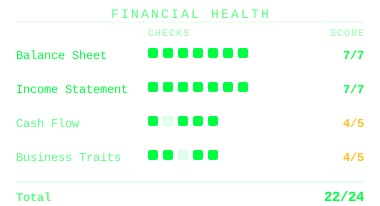
22 out of 24 checks passed.
For the full breakdown, see the detailed analysis on StockSnack:
→ StockSnack Home — https://stocksnack.app
→ NVDA Full Analysis (Pro Only) — https://stocksnack.app/screener/NVDA
What Does NVIDIA Corporation Actually Do?
Product Breakdown
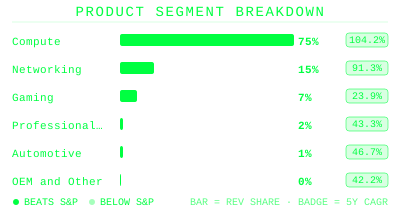 Top 1: Compute — 75% of revenue.
This segment provides high-performance computing platforms, primarily graphics processing units (GPUs) and related software for data centers, AI, and high-performance computing. Its customers are typically large enterprises and cloud providers. This segment accounts for $162.36B or 75.2% of total revenue and is a major growth engine for NVIDIA, with a 104% CAGR.
Top 2: Networking — 15% of revenue.
This segment offers high-speed interconnect solutions, including network interface cards and switches, designed to connect GPUs within data centers for AI and high-performance computing workloads. Its customers are data center operators and cloud service providers. This segment represents $31.38B or 14.5% of total revenue and is a strong growth area, with a 91% CAGR.
Top 3: Gaming — 7.40% of revenue.
This segment focuses on GPUs for personal computers, providing high-fidelity graphics and processing power for video games. Its customers are individual consumers and PC manufacturers. This segment contributes $16.04B or 7.4% of total revenue and is a steady earner, growing at a 24% CAGR.
Growth by Segment
All Segments by Growth (S&P 500 benchmark: 13% CAGR):
- Compute: 104% CAGR ✓ — This segment provides high-performance computing platforms, primarily graphics processing units (GPUs) and related software for data centers, AI, and high-performance computing. Its customers are typically large enterprises and cloud providers. This segment accounts for $162.36B or 75.2% of total revenue and is a major growth engine for NVIDIA, with a 104% CAGR.
- Networking: 91% CAGR ✓ — This segment offers high-speed interconnect solutions, including network interface cards and switches, designed to connect GPUs within data centers for AI and high-performance computing workloads. Its customers are data center operators and cloud service providers. This segment represents $31.38B or 14.5% of total revenue and is a strong growth area, with a 91% CAGR.
- Automotive: 47% CAGR ✓ — This segment develops AI platforms for autonomous vehicles and in-car infotainment systems, including chips and software for self-driving capabilities and advanced cockpit experiences. Its customers are automotive manufacturers. This segment accounts for $2.35B or 1.1% of total revenue and is a growing area, with a 47% CAGR.
- Professional Visualization: 43% CAGR ✓ — This segment provides GPUs and software for professional design, engineering, and content creation, enabling tasks like 3D modeling, animation, and scientific visualization. Its customers are professionals in various industries. This segment makes up $3.19B or 1.5% of total revenue and is a growing area, with a 43% CAGR.
- OEM and Other: 42% CAGR ✓ — This segment includes a variety of products for original equipment manufacturers (OEMs) and other niche markets, such as cryptocurrency mining processors and intellectual property licensing. Its customers are diverse, ranging from system builders to specialized industrial users. This segment contributes $619M or 0.3% of total revenue and is a growing area, with a 42% CAGR.
- Gaming: 24% CAGR ✓ — This segment focuses on GPUs for personal computers, providing high-fidelity graphics and processing power for video games. Its customers are individual consumers and PC manufacturers. This segment contributes $16.04B or 7.4% of total revenue and is a steady earner, growing at a 24% CAGR. On the other end, Gaming is the weakest performer at 24% CAGR. The Gaming segment is the weakest-performing product segment, with a 24% CAGR, as the consumer GPU market experiences more cyclical demand and increased competition compared to the booming data center market.
Geographic Performance
UNITED STATES: 118% CAGR · TAIWAN: 69% CAGR · Other Countries: 42% CAGR
Valuation
So, is NVIDIA Corporation overvalued? We look at EV/EBITDA and FCF Yield.
EV/EBITDA
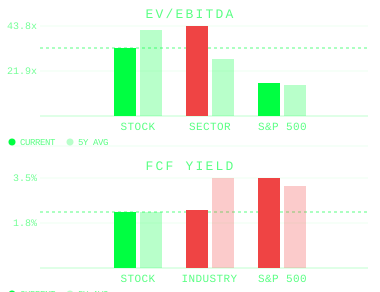
NVIDIA Corporation is valued at 33x EV/EBITDA. The sector's historical multiple is also 33x, making this the benchmark for our price target model.
FCF Yield
The current FCF yield is 2.2%, versus the industry average of 2.2%. Yield below peers suggests the market is pricing in stronger future growth.
NVIDIA currently trades at 32.96x EV/EBITDA, which is expensive compared to the S&P 500's typical ~15-16x. Wall Street prices NVIDIA at a premium due to its dominant position in the AI chip market, its strong brand, and its perceived long-term competitive advantage in data center and AI infrastructure. The FCF yield of 2.19% is slightly below the industry average of 2.25%, meaning investors are paying a higher price for each dollar of cash flow compared to peers.
Verdict
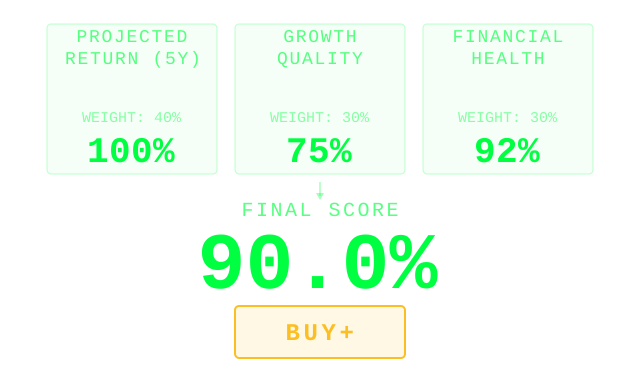
The numbers give NVIDIA Corporation a final score of 90.0/100 — signal: BUY+
NVIDIA Corporation is projected to return 6.99x over 5 years, compared to the S&P 500's projected 1.87x over the same period.
NVIDIA's projected return is very good, beating the S&P 500 by a multiple of 6.99x versus 1.87x. The company shows solid revenue growth, but its income and FCF growth are starting to decelerate. Its balance sheet is very strong, indicating excellent financial condition. The stock is expensive, priced at a premium compared to the broader market and its industry. This stock suits growth investors who believe in NVIDIA's continued dominance in AI and are comfortable with a high valuation, expecting future innovation and market expansion to justify the current price.
→ Full analysis on StockSnack https://stocksnack.app
→ NVDA Full Analysis (Members Only) https://stocksnack.app/screener/NVDA
(Score: price projection 100/100 × 40% · growth quality 75/100 × 30% · financial health 92/100 × 30%)
Want to run the numbers yourself? Every stock in our screener gets the same projection — blending two valuation methods, benchmarked against the S&P 500. Explore all 500 stocks on StockSnack →
Not financial advice. Always do your own research.