PepsiCo (PEP): Growth Slows, Valuation Stretches
5 Year Overview
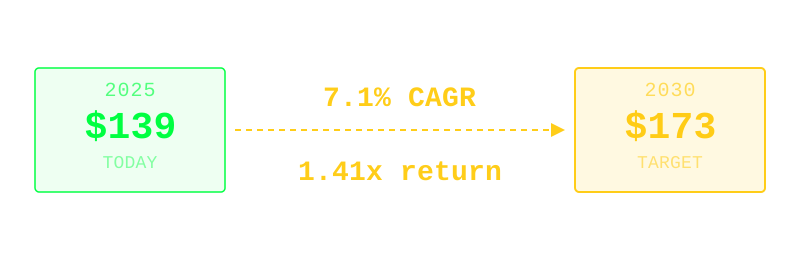
Right now, PepsiCo, Inc. trades at $139. Based on its historical financial performance, the data points to $173 in five years — that is 1.41x, or 7.1% CAGR. The S&P 500 is projected at 1.88x over the same period. That puts it 47% behind the S&P 500 over the same period.
Why 1.41x in 5 Years?
EBITDA Method
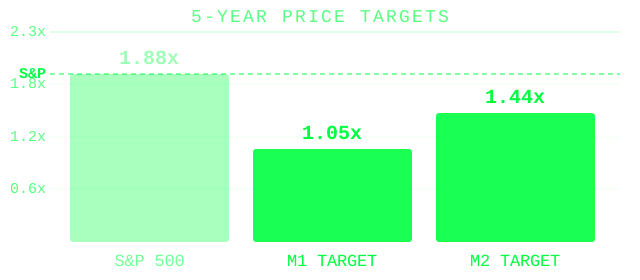
The current EBITDA is $15B and is projected to reach $15B in five years — that is 0.6% annual growth. Applying the sector's historical multiple of 15x EV/EBITDA gives a price target of $146, or 1.05x from today — behind the market.
PepsiCo's projected return of 1.41x trails the S&P 500's 1.88x. This is because the company's EBITDA growth rate is a slow 0.56% over five years. PepsiCo operates in mature beverage and snack markets, which limits rapid top-line expansion and makes significant EBITDA growth challenging despite strong brand power. The market's valuation of 15.39x EV/EBITDA is in line with the S&P 500 average, reflecting its stable, defensive business model rather than high growth expectations.
Free Cash Flow Method
The current free cash flow is $7.67B and is projected to reach $9.98B in five years — that is 5.9% annual growth. With an estimated FCF yield of 3.6%, this gives a price target of $201, or 1.44x from today — behind the market.
The FCF-method price target of 1.44x trails the S&P 500's 1.88x. The company's FCF growth rate of 5.85% is moderate, but its FCF yield of 4.03% is higher than the industry average of 3.46%. PepsiCo's FCF generation is consistent, driven by strong brand loyalty and efficient operations, though ongoing investments in supply chain and product innovation consume a portion of cash flow. The current FCF yield of 4.03% is above the industry average of 3.46%, indicating investors get more cash flow per dollar invested compared to peers.
Blending both methods, the data points to $173 in five years, against today's $139.
Is It Still Growing?
Revenue
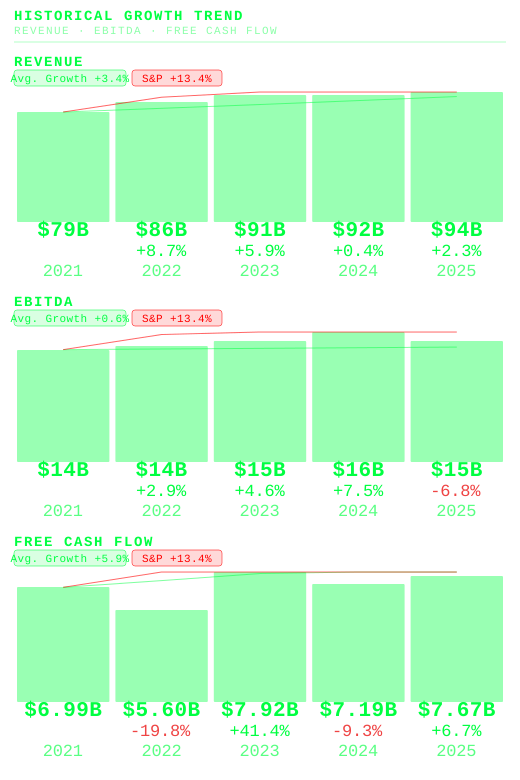
In FY2025, PepsiCo, Inc. brought in $94B in revenue, with a 5-year CAGR of 3.4%.
The largest revenue increase was 8.7% in FY2022. This growth was driven by strong pricing power and increased demand for both beverages and convenient foods, particularly in the PepsiCo Beverages North America segment, which contributed $28.197 billion or 42.5% of total revenue.
EBITDA
In FY2025, EBITDA came in at $15B, with a 5-year CAGR of 0.6%.
The largest net income swing was a decline of 13.8% in FY2025. This was accompanied by a slight compression in gross margin from 54.6% to 54.1% and a more significant drop in net margin from 10.5% to 8.8%, reflecting increased operating costs and potentially higher marketing spend. In FY2025, revenue grew by 2.3% while EBITDA declined by 6.8%, indicating that costs rose faster than revenue and put pressure on profitability.
Free Cash Flow
Free cash flow for FY2025 was $7.67B, with a 5-year CAGR of 5.9%.
The largest FCF swing was an increase of 41.4% in FY2023. Operating cash flow rose from $10.811 billion in FY2022 to $13.442 billion in FY2023, while capital expenditures increased from -$5.207 billion to -$5.518 billion. This significant FCF jump reflects strong operational efficiency and effective working capital management, allowing the company to convert more of its earnings into cash despite ongoing capital investments.
Growth Overview
Revenue growth is slowing, with a 3-year CAGR of 1.52% compared to the 5-year CAGR of 3.35%. EBITDA growth is also slowing significantly, showing a 3-year CAGR of -6.24% versus a 5-year CAGR of 0.56%. EBITDA is growing much slower than revenue, indicating that costs are rising faster than sales and putting pressure on the company's profitability per dollar earned. Free Cash Flow is growing significantly faster than EBITDA, which means the company is efficiently converting its earnings into cash without excessive spending on physical assets or working capital. Overall, this is a company that is losing momentum on its core profitability metrics, even as it maintains strong cash generation.
Financial Health
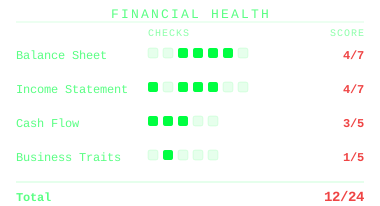
12 out of 24 checks passed.
PepsiCo's financial health is mixed, showing some areas of strength but also several significant concerns. Failed checks include "Cash/Debt > 1.0" and "Debt/Equity < 80%", indicating the company holds less cash than debt and has a higher debt load relative to equity than desired. "ROTA > 10%" failed, meaning the company is not generating sufficient returns from its total assets. "Net Margin > 20%" failed, showing profitability is below a strong benchmark. "CapEx / NI < 25%" failed, suggesting capital expenditures are high relative to net income. "Payout Ratio < 1" failed, meaning the company pays out more in dividends than it earns. "ROIC > 15%" failed, indicating inefficient capital allocation. "Intangibles < 10%" failed, showing a significant portion of assets are intangible. "Debt Payoff < 4 Years" failed, meaning it would take more than four years to pay off debt with current earnings. "$1 Retained Test" failed, suggesting retained earnings are not generating sufficient value. The company consistently passes "Preferred Stock = 0", "Active Buybacks", "ROE > 25%", "Gross Margin > 40%", "R&D / GP < 30%", "Interest / OpInc < 15%", "Tax Rate 15-25%", "SBC / Revenue < 10%", "OCF > Net Income", and "Owner Earnings > 0". These indicate strong profitability, efficient operations, and effective capital management in several key areas. While the company demonstrates operational efficiency and strong cash generation, its high debt levels and lower returns on assets and capital undermine its overall financial health and growth story.
For the full breakdown, see the detailed analysis on StockSnack:
→ StockSnack Home — https://stocksnack.app
→ PEP Full Analysis (Pro Only) — https://stocksnack.app/screener/PEP
What Does PepsiCo, Inc. Actually Do?
Product Breakdown
Growth by Segment
Geographic Performance
Europe, Middle East & Africa (Segment): 5.5% CAGR · International Beverage Franchise: 4.7% CAGR · Asia Pacific Foods (Segment): 1.6% CAGR
Valuation
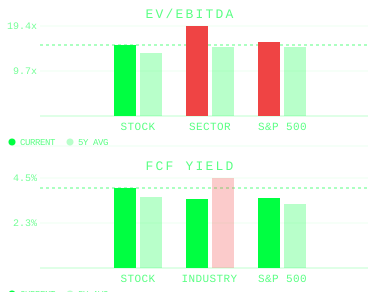
So, is PepsiCo, Inc. overvalued? We look at EV/EBITDA and FCF Yield.
EV/EBITDA
PepsiCo, Inc. is valued at 15x EV/EBITDA. The sector's historical multiple is also 15x, making this the benchmark for our price target model.
FCF Yield
The current FCF yield is 4.0%, versus the industry average of 3.5%. A higher yield means you are getting more cash flow per dollar invested compared to peers — a positive signal.
PepsiCo currently trades at 15.39x EV/EBITDA, which is in line with the S&P 500 average. Wall Street broadly views PepsiCo as a stable, defensive stock with strong brands and consistent cash flows, justifying a market-average multiple despite its slower growth profile. The current FCF yield of 4.03% is higher than the industry average of 3.46%, meaning investors are getting a better deal on cash flow compared to peers.
Verdict
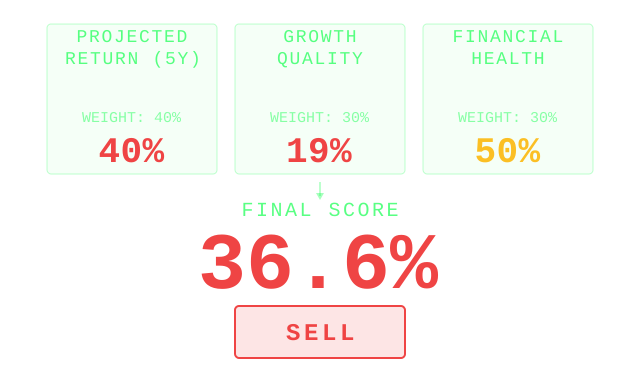
The numbers give PepsiCo, Inc. a final score of 36.6/100 — signal: SELL
PepsiCo, Inc. is projected to return 1.41x over 5 years, compared to the S&P 500's projected 1.88x over the same period.
The main drag is the growth quality score (19/100) — the business fundamentals have not yet matched the strong price projection. PepsiCo's projected 5-year return of 1.41x, including $23.43 in cumulative dividend income per share, falls short of the S&P 500's projected return of 1.88x. The company's growth signal is deteriorating, with both revenue and EBITDA growth slowing down. Its financial health is mixed, showing strong operational cash flow but also concerns regarding debt levels and capital efficiency. The stock trades at 15.39x EV/EBITDA, which is fairly priced compared to the broader market. This stock suits investors seeking stable dividend income and defensive characteristics in a mature market, but it requires a belief that PepsiCo can reignite growth or maintain its premium valuation despite slowing fundamentals.
→ Full analysis on StockSnack https://stocksnack.app
→ PEP Full Analysis (Members Only) https://stocksnack.app/screener/PEP
(Score: price projection 40/100 × 40% · growth quality 19/100 × 30% · financial health 50/100 × 30%)
Want to run the numbers yourself? Every stock in our screener gets the same projection — blending two valuation methods, benchmarked against the S&P 500. Explore all 500 stocks on StockSnack →
Not financial advice. Always do your own research.